Rhindon - Peter Pevensie’s Sword
Rhindon, Peter Pevensie's sword, has become one of the most iconic weapons from The Chronicles of Narnia. Since the release of the films, it has inspired an official licensed replica as well as numerous unofficial reproductions, each with its own interpretation of the original movie prop. In this article, we'll take a closer look at the sword as it appears on screen, compare it with the official licensed replica and the versions currently available on the market, and explain how our upcoming replica is taking a different approach. Whether you're a long-time collector or considering your first Rhindon replica, this guide will give you a better understanding of what sets each version apart and what you can expect from our project.
The Movie Version of Rhindon
Like most hero weapons created for major film productions, Rhindon was not a single sword. Instead, several versions were produced, each designed for a specific purpose during filming. While they all represented the same weapon on screen, their materials, construction, and level of detail varied depending on the scene.
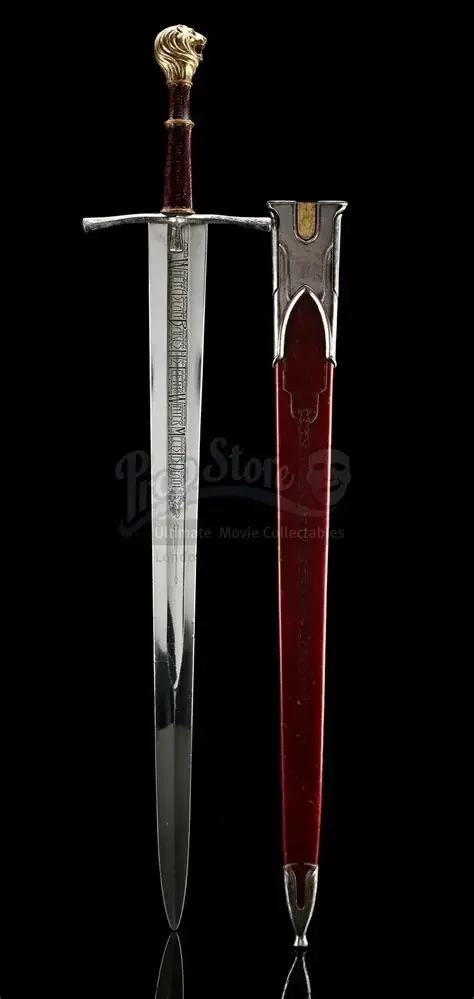
The steel hero prop was the definitive version of Rhindon and the one used for close-up shots. It featured the highest level of craftsmanship, with finely finished metal fittings, a hand-wrapped leather grip, and a carefully weathered finish to give the sword a believable, battle-worn appearance. Whenever the camera focused on Peter drawing, carrying, or presenting the sword, this was typically the version audiences saw. Because it was built for visual accuracy rather than intensive stunt work, it was handled with great care throughout production.
For fight choreography and extended action scenes, lighter aluminium versions of Rhindon were produced. These swords closely matched the appearance of the hero prop but were significantly lighter, allowing the actors to perform complex movements with less fatigue while reducing the risk of injury during repeated takes. Although highly convincing on camera, these stunt swords often featured simplified construction, softer detailing, and finishes designed to withstand the demands of filming rather than withstand close inspection.
Certain scenes required even safer alternatives. For moments involving heavy impacts, falls, or close contact between actors, flexible rubber stunt swords were used to minimise the risk of injury. In some cases, lightweight resin versions were also produced for scenes where a rigid metal sword wasn't practical. These props replicated the overall silhouette of Rhindon but omitted much of the fine detail found on the hero prop. Their purpose was functionality and safety, relying on camera angles, lighting, and post-production to convincingly portray the same sword on screen.
Why This Matters
When discussing screen accuracy, it's important to understand that there is no single "movie Rhindon." The sword exists as a family of props, each serving a different role during production. As a result, small differences can be found between surviving reference images depending on which version was photographed.
Let’s take a look at some of those differences.
Differences Between the Movie Versions
As we already discussed, there was never a Rhindon, but Rhindons. As a result, the various props naturally differ from one another in both construction and appearance.
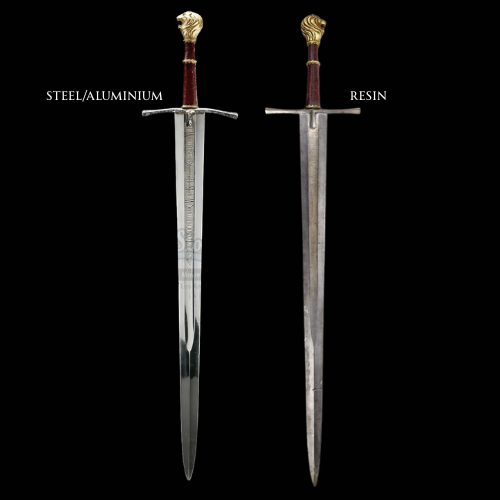
The most noticeable difference, although one that often goes unnoticed on screen, is between the steel and aluminium swords and the resin stunt versions.
On the steel hero prop and the aluminium stunt swords, the blade is made from metal, giving it a realistic metallic sheen that catches the light throughout the films.
The crossguard, pommel, and other metallic fittings are also separate cast metal components, assembled around the grip just like a real sword.
The resin stunt versions, however, were built differently. To make them as safe and lightweight as possible, the entire sword—including the blade, crossguard, pommel, and other fittings—was cast in resin. As a result, the blade loses its metallic appearance, taking on a flatter grey finish with little to no natural shine. Likewise, the pommel and guard are no longer separate metal pieces but are believed to be moulded separately and attached to the sword’s main body. Resulting in softer details and a noticeably different look when viewed up close.
These differences are rarely apparent during the films, thanks to lighting, camera angles, and post-production.
However, when studying behind-the-scenes photographs or production references, they become immediately recognisable and are an important consideration when aiming to create a truly screen-accurate replica.
Despite these differences in construction and materials, the overall design of each Rhindon remained consistent throughout production. The shape of the pommel, the proportions of the guard, and details such as the engraved emblem matching Peter's shield were all retained across the various versions, ensuring the audience always recognized the same sword on screen.
Over time, however, many of these production props have aged differently. The resin stunt versions, in particular, are more susceptible to wear, cracking, chipped paint, and other forms of deterioration. Even the metal hero and aluminium stunt swords have developed their own imperfections through years of handling, storage, and display. As a result, no two surviving Rhindons look exactly alike today. Natural ageing, production repairs, and accumulated damage have given each prop its own unique character, making it even more challenging to determine what the sword originally looked like during filming.
The Official Licensed Replica
When The Chronicles of Narnia films were released, the world of movie collectibles looked very different than it does today. High-end prop replicas, fan-made reproductions, and independent studios were far less common, meaning officially licensed merchandise was often the closest fans could get to owning a piece of the films. Nowadays it’s easy to assume that an officially licensed replica is automatically the most accurate representation of the original movie prop. But in reality, that's not always the case. A licensed product is approved, but accuracy ultimately depends on the references, production timeline, manufacturing methods, and design decisions made during development.
MASTER REPLICAS
In the mid-2000s, Master Replicas partnered with Disney and Walden Media to produce a small range of officially licensed collectibles for The Chronicles of Narnia. Among them were the White Witch's Wand and Peter Pevensie's sword, Rhindon.
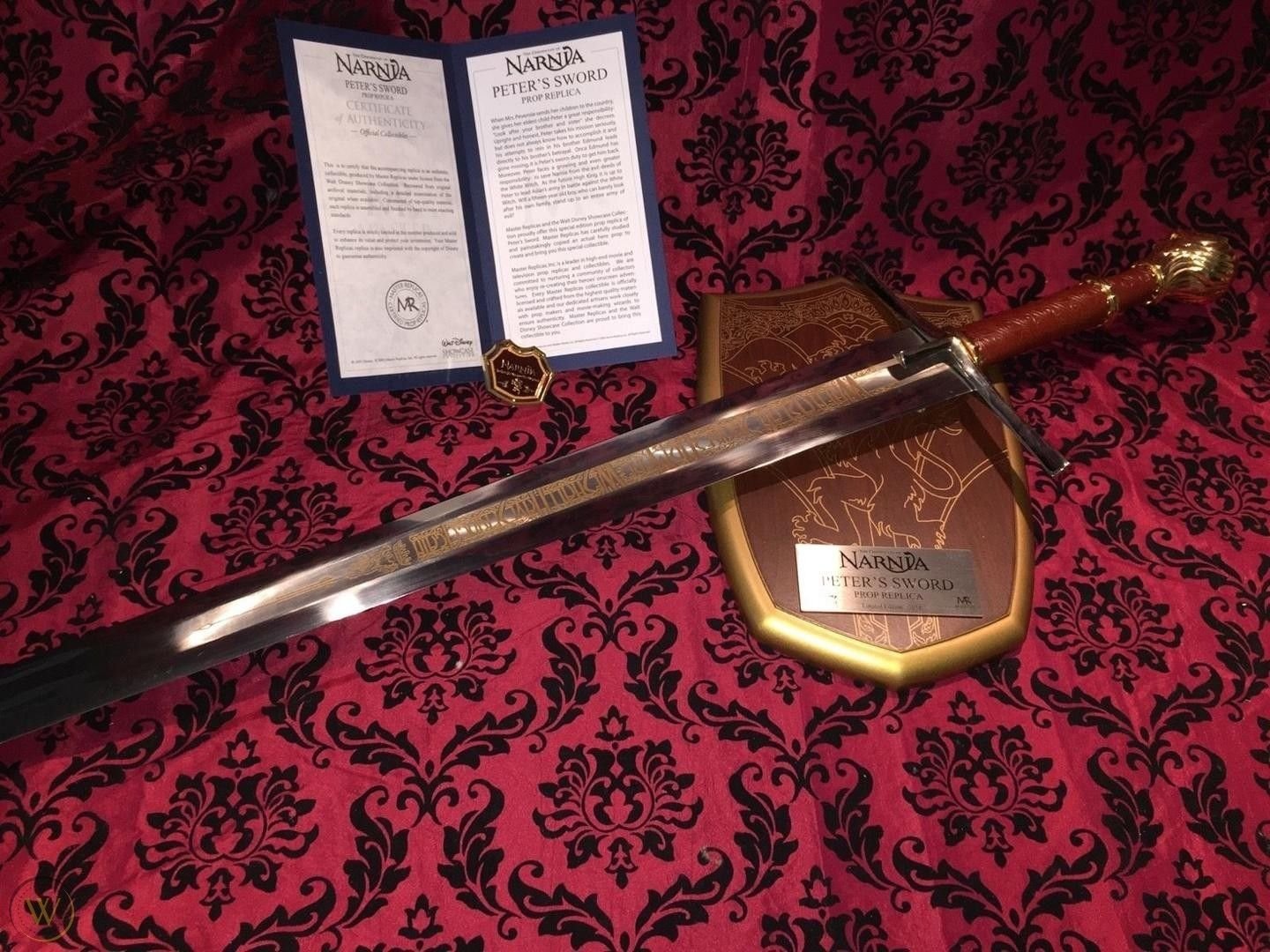
Rhindon’s replica was an outstanding collectible. It featured a polished steel blade with etched engravings, a genuine leather-wrapped grip, metal fittings, and elegant wooden wall display. For many collectors, it represented the ultimate version of Peter's sword and remains one of the most desirable Narnia collectibles ever produced. However, it is important to remember that the Master Replicas sword was a licensed replica, and even officially licensed replicas can differ from the original movie props.
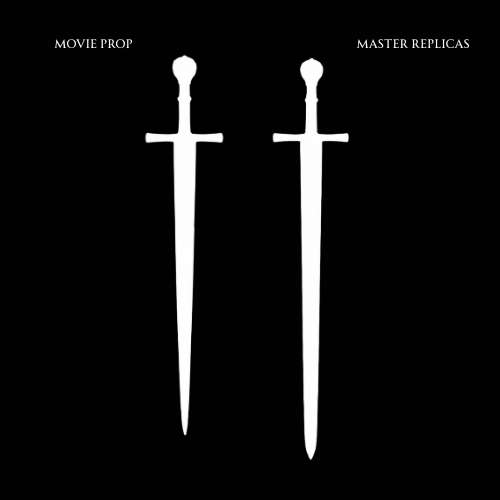
The most noticeable difference is the shape of the blade. On the original film prop, the blade begins tapering immediately from the crossguard, creating a long, elegant profile that gradually narrows all the way to the tip. This subtle geometry is one of Rhindon's defining characteristics and gives the sword its graceful silhouette.
The Master Replicas version approaches this differently. Instead of maintaining a continuous taper, the blade remains comparatively wide for much of its length before narrowing much more aggressively near the tip. This creates a noticeably different profile, making the end of the blade appear shorter, broader, and more abrupt than the sword seen on screen.
The reason for this discrepancy is unknown. It's possible the replica was designed using early production references before the final hero prop had been completed, or that compromises were made during development to simplify manufacturing. Whatever the reason, the blade profile is one of the clearest examples that an officially licensed product is not necessarily an exact copy of the original filming prop.
Another difference with the Master Replicas sword is the finishing. Licensed replicas usually nail the overall look and feel of the original prop, often right down to the smallest details. However, where they often fall short is in the finish itself. For some collectors, that's a noticeable downside.
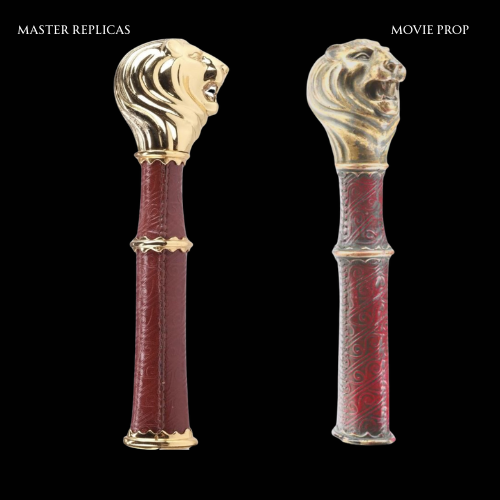
As far as officially licensed replicas go, studios often have little say in how a product is ultimately finished. Their goal is to present an idealized version of the prop—a flawless display piece that showcases the design at its very best, with nothing distracting from its appearance. The Master Replicas version is that exact definition of a pristine, high-end display piece. The gold pommel is bright and polished, the leather is clean and untouched, and the entire sword has a beautiful, elegant appearance. But that's exactly the point, that’s how a replica looks, not a movie prop.
The original movie prop feels much more lived in. It has subtle weathering that makes it look like it actually belonged in the world of the film. The pommel has worn areas and weathering that help Aslan's lion head stand out more naturally, while the leather grip shows darker spots and slight grime where oils from hands and everyday use would realistically build up. These are small details, but they give the sword a sense of history and authenticity without compromising the craftsmanship or quality.
Licensed replicas are often made to look factory-fresh and flawless, while the actual movie props were built to look like they had been used. For many collectors, that weathered, screen-used appearance is exactly what makes a prop feel authentic—and it's something licensed replicas often fail to capture.
The Scabbard
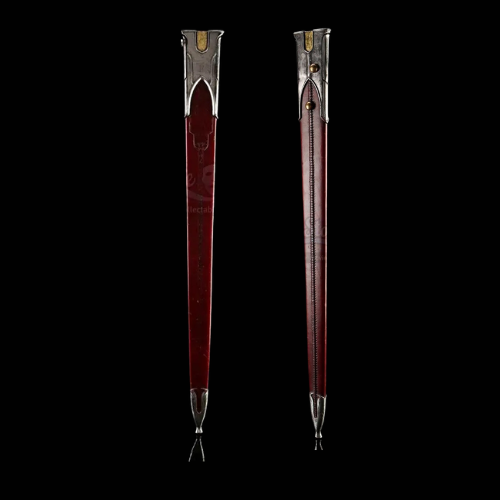
While the Master Replicas sword is an outstanding replica for any Narnia fan, one important piece is surprisingly absent: Peter's scabbard. For a collectible of this caliber, it's something many big collectors would naturally expect to be included. The scabbard isn't just a storage accessory; it's an integral part of the sword's design and of Peter's appearance throughout the films. Nearly every time the sword is seen on screen, it's worn at his side in its distinctive leather scabbard, making the two inseparable. Including only the sword leaves the display feeling slightly incomplete, especially for collectors looking to recreate what they saw in the movie. A matching screen-accurate scabbard would have elevated the piece even further and provided a more complete representation of Peter's iconic weapon
Although we can understand why Master Replicas ultimately chose not to include a scabbard. The replica was designed to be displayed on its wall plaque with the sword unsheathed, allowing collectors to fully appreciate the blade engravings and craftsmanship. From that perspective, a scabbard could have been seen as an optional accessory rather than a necessity. It's understandable why certain compromises were made. Producing a few hundred licensed replicas means balancing accuracy with manufacturability, durability, and cost.
Conclusion on MASTER REPLICAS’S Rhindon
Despite its inaccuracies, the Master Replicas Rhindon fully deserves its reputation. For nearly two decades, it has stood as the definitive licensed representation of Peter Pevensie's sword and remains one of the most iconic pieces of The Chronicles of Narnia memorabilia ever produced. Its craftsmanship, choice of materials, and overall presentation were exceptional for its time, and it continues to be a prized collectible among fans.
At the same time, the collecting landscape has changed dramatically since 2005. Today, collectors expect a level of screen accuracy that simply wasn't the primary focus of many licensed replicas released during that era. Access to high-resolution production stills, behind-the-scenes photography, and surviving movie props has made it possible to study details that were once impossible to verify.
We see this replicait as an important milestone in Narnia collecting history. It introduced countless fans to Rhindon and proved there was a demand for premium Narnia replicas.
Replicas Available on the Market Today
Chances are you came across these already, because over the years, dozens of manufacturers have released their own versions of Rhindon. While these replicas are sold under different brand names and often advertised as movie-accurate, the vast majority are actually the exact same sword, produced by the same manufacturers and simply rebranded by different retailers.
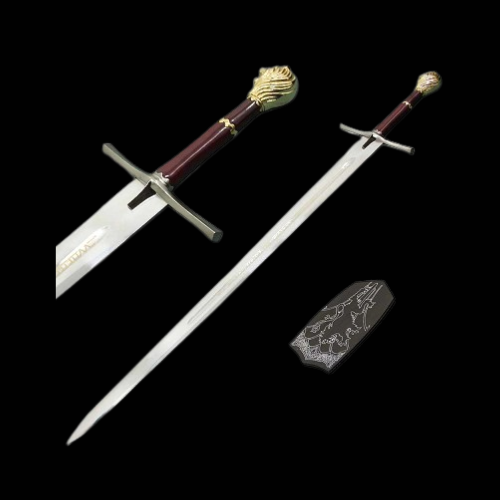
These replicas are an excellent entry point for fans looking to own a Rhindon without spending hundreds or even thousands of dollars. For a relatively low price, buyers receive a full-metal sword with a steel blade, a colour scheme that closely resembles the version seen in the films, and a display piece that is inspired by the MASTER REPLICAS display piece.
However, the affordable price comes with inevitable compromises.
These swords are not handmade but mass-produced in large quantities and sold by countless retailers around the world. Their focus is accessibility rather than screen accuracy. For their price, they offer a solid introduction to Rhindon.
To keep production costs low, many of the finer details have been simplified or omitted altogether. The grips in the films are typically wrapped with genuine leather with a distinced engraving pattern in them. These versions always lack this embossed leather detailing found on the movie props.
The lion pommel also differs noticeably from the original design, with softer features and different proportions. The blade engravings are also inconsistent: while the real Rhindon features both "When Aslan bares His teeth, winter meets its death." and "When Aslan shakes His mane, we shall have spring again.", many commercial replicas include only the second inscription—or omit the engravings entirely.
The blade tapering itself appears to take inspiration from the MASTER REPLICAS version rather than the original filming prop. However, it is generally wider, longer, thicker, and less refined, resulting in proportions that differ much further from the movie sword. Similar compromises can be found throughout the rest of the replica, from the guard and pommel to the grip and overall finish.
As a result, while these replicas successfully capture the general appearance of Rhindon and make for impressive display pieces, very few of the individual details accurately reflect the sword seen in The Chronicles of Narnia. They represent an interpretation of Rhindon rather than a faithful recreation of the original movie prop.
None of this means these replicas are lesser swords. On the contrary, they have introduced thousands of fans to collecting The Chronicles of Narnia memorabilia and continue to offer an affordable way to own a recognizable version of Rhindon. For collectors who simply want a decorative display piece or are just beginning their collection, they represent excellent value for money and capture the overall spirit of Peter Pevensie's sword.
However, collectors seeking the closest possible representation of the original filming prop will begin to notice the many differences in shape, proportions, materials, and detailing.
Creating the Most Screen-Accurate Rhindon Yet
After examining the original movie props, the official Master Replicas release, and the mass-produced replicas available today, we've gained a clear understanding of what each version gets right—and where each falls short. Every one of them has taught us something valuable about Rhindon and helped shape the direction of our own project. Our goal, however, is different. Rather than recreating the Master Replicas sword or following the design used by today's commercial replicas, we're returning to the original filming props themselves. Every proportion, engraving, casting, contour, and material choice is being carefully researched using available production references, behind-the-scenes photography, and surviving props wherever possible. Throughout the development process, we'll take what previous replicas did well, correct the areas where accuracy was lost, and recreate the countless subtle details that make Rhindon unique. Our aim is not simply to produce another beautiful sword, but to create the closest representation of Peter Pevensie's screen-used Rhindon, that we as a small independent studio can possibly achieve.
If there were no limitations, we'd recreate Rhindon exactly as it was made for the films. Unfortunately, that's simply not possible for us. As a small, fan-funded, unlicensed studio, we don't have the financial backing or production resources of a major film studio. Manufacturing a full steel Rhindon with individually cast metal fittings, while keeping it affordable for collectors, would place the project far beyond our reach. That forced us to ask ourselves an important question: What makes Rhindon feel like Rhindon?
For us, the answer isn't simply the materials hidden beneath the surface—it's the appearance. Our goal is to recreate the look of the original hero prop as faithfully as possible, while making smart compromises where they have the least impact on the final result.
The Sword
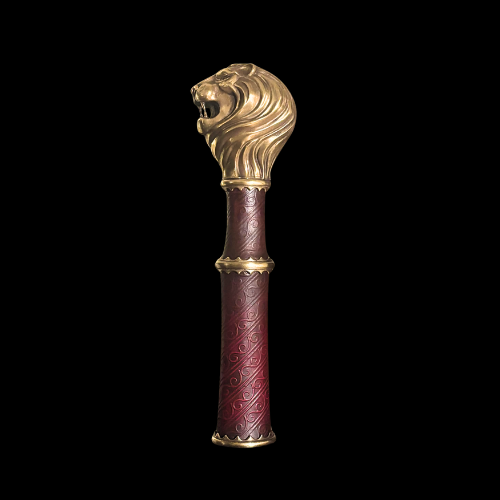
We'll be recreating the polished hero version of Rhindon as much as possible, complete with its reflective blade, genuine embossed leather grip, rich weathering, and the subtle details that give the original sword its distinctive character. To achieve the appearance of a steel blade, we're applying many of the same techniques developed for our Lucy Pevensie's Dagger replica. Instead of solid steel, the blade will feature a resin core with a palladium-plated surface. This gives the visible exterior a genuine metal finish that reflects light like polished steel, while keeping the sword lighter and significantly easier to manufacture. The pommel specifically will receive 24-karat gold plating, while the grip will be wrapped in real embossed leather, closely matching the construction and appearance of the original filming prop.
Combined with an accurate sculpt, carefully researched proportions, and authentic surface finishing, these material choices allow us to prioritise what collectors actually see. Although the sword won't be constructed exactly like the movie prop beneath the surface, our aim is for it to capture the same visual impact and presence as the hero Rhindon seen on screen.
The sheath
We believe Rhindon should be displayed as a complete set. That's why every replica will include a matching scabbard. The scabbard will be fully wrapped in leather, feature plated metal fittings to match the sword, and include a lined interior to ensure the blade fits securely while remaining protected during display and storage.
The Stand
To complete the package, every Rhindon replica will also include a wall-mounted display stand. Like the sword and scabbard, the stand is being designed specifically for this project.
Our goal is to create a display worthy of the sword itself—one that allows Rhindon and its scabbard to be showcased together as they would in a collector's display. The stand will be sturdy, easy to mount, and designed to securely support the replica while complementing its appearance rather than distracting from it.
We believe a premium replica deserves a complete presentation. By including the scabbard and wall mount as standard, every collector will have everything needed to display Rhindon straight out of the box, without the need for additional accessories or aftermarket solutions.
The Most Important Part
Unlike large studios or licensed manufacturers or the resources to develop projects like Rhindon before knowing whether there's enough interest. Every replica we create is made by hand and possible by the support of our community. That's why we work with a pre-order model.
Pre-orders allow us to measure the true demand for a project while providing the funding needed for research, prototyping, mould making, tooling, and production. Without that support, our replicas simply wouldn’t exist.
We also understand that asking collectors to pre-order a product before a prototype exists requires an enormous amount of trust. It's a trust our community has placed in us time and time again with each pre-order release, and one we never take for granted.
Today, we don't have a finished Rhindon to show you. There are no prototypes, no renders, and no production samples. What we do have is months of research, countless hours spent studying the original movie props, and a clear vision of what we want this replica to become. That's why we've chosen to share all of this information. Anyone can create a replica. But understanding why it should look a certain way, how it differs from every version that came before it, and what makes the original Rhindon so special—that is what ultimately shapes the final result.
If you've made it this far, thank you for taking the time to learn about this project. Whether you decide to support the pre-order or simply enjoyed learning more about Peter Pevensie's sword, we're grateful to have you as part of the Narnia Replica Props community.
We can't wait to bring Rhindon to life—together.
Price excluding taxes/VAT & shipping
LIMITED EDITION OF 5
3 pre-orders required for creation approval
Processing time: 3-7 months
Pre-order product - 50% of the item total is non-refundable upon cancellation.
Processing time ~ 3–6 months
Replica Collection
