Rhindon Grip Prototype V1 Deepdive
With many replicas, there are sections that are naturally more difficult to recreate than others. For Peter's Rhindon, one such section was the complete grip itself. What appears at first to be a relatively simple red leather grip hides a surprising number of secrets. Subtle tapering, changing proportions, ornamental fittings, embossed leatherwork and carefully chosen finishes all work together to create the final appearance.
Getting Rhindon's grip right sets the foundation for everything that follows. If the proportions or transitions are wrong here, those inaccuracies will carry into the guard, pommel and eventually the silhouette of the complete sword.
For us, this also made the grip the perfect proof of concept to develop before pre-orders officially go live. This time we did not want to ask collectors to rely on references and promises alone. Prototype V1 is our first physical glimpse at what Rhindon could become. And, as we quickly discovered, even a small piece of a sword can hide an incredible amount of work.
1. Reconstructing the Grip
Recreating Rhindon's grip began where most of our Replica Collection projects begin: with reference material. Unfortunately, swords rarely present themselves in a perfect side, front and top view. Photographs are taken from different angles, lenses distort proportions, and important sections are often hidden by hands, costumes or simply poor lighting. This meant comparing every usable image of Rhindon we could find and slowly piecing the grip together. The length of each leather section, the changing width of the core, the placement of the ornamental fittings and even the overall shape of the grip had to be estimated and compared repeatedly. And this is exactly where Prototype V1 became invaluable.
Luckily for us, Rhindon is one of the most photographed and researched props from The Chronicles of Narnia films. This meant we were able to secure references from almost every angle, alongside original measurements taken from the real prop. For a replica studio, that is the best thing you could hope for. Soon, the design began to undergo countless changes. Different proportions were tested and ferrule after ferrule was redesigned. We are not talking about four or five variations, but closer to twelve/ thirteen. Each one was either slightly too tight, slightly too loose, or simply did not account correctly for the final thickness of the leather. Designing these pieces while simultaneously predicting how stamped and formed leather would behave was anything but easy.
The tapered handle itself was originally designed as a single piece, with one continuous section of leather wrapping around the core. However, further study of the original prop led us to believe that Rhindon's grip may actually be divided into two separate sections. The central ferrule appears to conceal the transition and visually join both halves together. So, we returned to the design and separated the grip into two individual cores, each receiving its own independently formed and stitched leather wrap.
The Lion
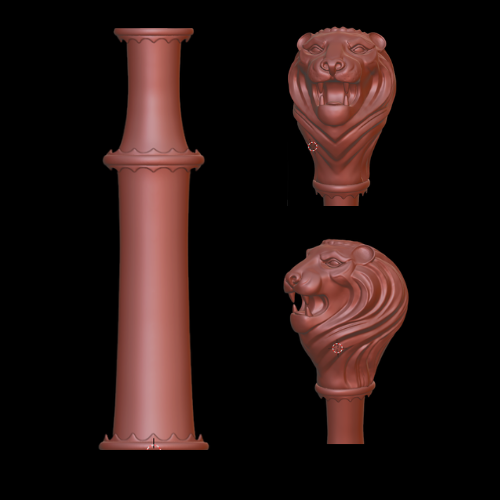
The lion pommel was, without question, the most difficult part of the entire prototype. There are numerous references to Rhindon—and numerous slightly different lions. Lighting, angles, different props and reproduction pieces can all create conflicting information. The design needed to be approached carefully. There was very little room for error. This was not a small detail, where the tiny scale of the finished piece could help hide microscopic differences. We were sculpting a lion head measuring approximately 6 × 6 centimetres, standing proudly and openly as Rhindon's pommel. It needed to be right.
In the end, approximately 48 hours of design work went into the pommel alone. For perspective, that is roughly the amount of time many of our other replicas take to design in their entirety. Organic forms are unforgiving. A small change to the muzzle, brow or width of the skull can completely alter the character of the sculpture. After countless adjustments, we once again discovered that the eyes were perhaps the most important part of all. Their spacing. Their size. Their depth beneath the brow. Each was carefully adjusted against the original pommel until the lion finally began to carry the same expression and character as Rhindon itself.
Forty-eight hours for a single pommel may sound excessive. But for Rhindon, “close enough” was never going to be enough.
2. The Core
One of the most important decisions in recreating Rhindon could never be seen from the outside. Beneath the leather grip and running through the entire blade lies the replica's structural core. Our interpretation had to meet a solution it needed to feel solid, durable and convincing in the hands of collectors for years to come.
Early in development we explored several internal construction methods. Carbon fibre offered exceptional strength while keeping the blade extremely thin, making it an attractive solution from an engineering perspective. However, after extensive evaluation, we concluded that absolute rigidity and a realistic weight distribution were more important than achieving the lightest possible construction.
For that reason, Rhindon is planned to be built around a full-length precision flat steel core that extends from the pommel through the blade. This provides a rigid and thin internal foundation, minimising flex while giving the replica the reassuring weight.
3. Recreating Rhindon's Leatherwork
With the grip cores finally taking shape, we arrived at an entirely different challenge: the leather. At first glance, Rhindon's grip appears to be wrapped in relatively simple red leather. Look closer, and an intricate pattern of diagonal lines and flowing ornamental shapes begins to emerge across its surface. Recreating this pattern meant returning once again to the original prop. Every visible section was studied, compared and reconstructed before being translated into a pattern that could physically be pressed into real leather. The difficulty was not simply creating something that looked correct while flat. It also needed to remain crisp once dyed, formed and tightly wrapped around a tapered grip.
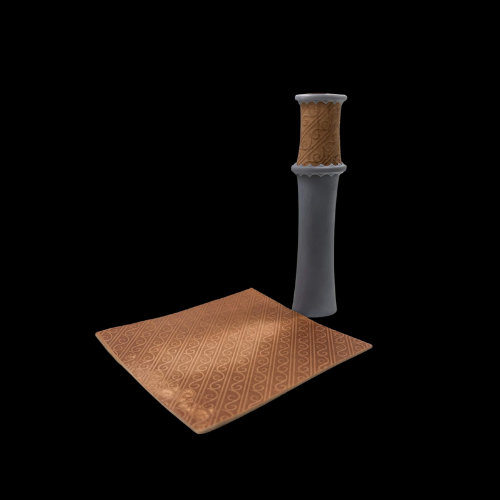
And this is where material testing became essential. Several different leathers were considered and tested. Softer, thinner leather proved considerably easier to wrap around the grip, but introduced an immediate problem: the detail simply did not survive. Patterns that looked acceptable directly after stamping quickly became weak and almost disappeared as the leather was curved around the handle. Eventually, we returned to our most trusted leather. It was more difficult to form and considerably less forgiving during assembly, but the difference in detail was undeniable. The deepest lines remained visible, the ornamental shapes stayed crisp, and the leather retained the strong sculpted appearance visible on the original Rhindon grip. Of course, choosing the leather only created our next problem.
A Pattern Measured in Millimetres
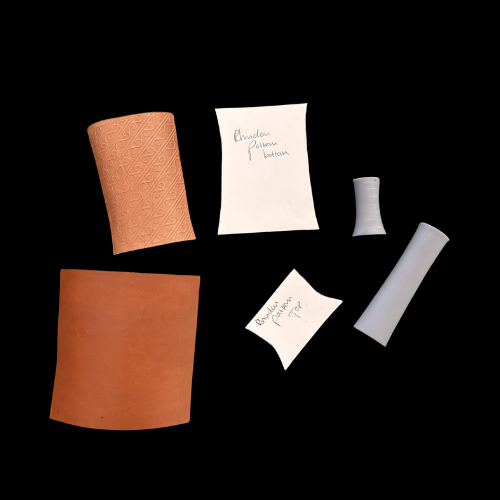
Our first leather patterns did not fit, there were around 5 of those. The gap at the rear seam was too large to close comfortably through stitching alone. Even a difference of only a few millimetres placed enormous tension on the stitch holes and threatened to distort the embossed design.
So, the patterns changed, Then changed again and changed again… Measurements were adjusted to account not only for the circumference of the grip, but also the thickness of the leather itself, the compression caused by stamping made the leather thinner, so the measurements had to account for that. Even the small amount of stretch introduced during forming had to be taken into consideration.
Eventually, we arrived at a pattern that could be tightly wrapped around the core and pulled together through hand stitching at the rear. It is perhaps one of the least ‘interesting’ parts of the finished replica. Yet it took an extraordinary amount of testing to get right. That became a recurring lesson throughout Prototype V1: the simplest-looking details were often hiding the most work.
4. Finding Rhindon's ‘Red’
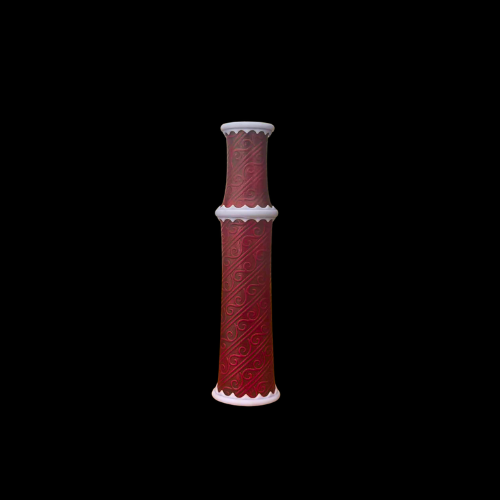
With the leather selected and the first patterns successfully stamped, we moved on to colour. Both movies show a different finish on Rhindon’s grip. Rhindon's grip is red—but simply calling it red does the original prop very little justice. Depending on the lighting, movie, and scene the leather shifts between deep burgundy, crimson and an almost jewel-like ruby tone. The embossed recesses appear considerably darker, while the highest sections of the pattern catch brighter red highlights. A single coat of red paint was never going to recreate that depth.
Our first successful test actually came from a process that took several days. After stamping, the leather was left to completely dry for 24 hours. It was then treated and allowed to rest for 24 hours again before receiving its red dye. Then, another 24-hour wait. It was only once the leather had completely dried that the colour truly revealed itself. Ruby red. Further colour was then carefully introduced with an airbrush. Darker tones were built into the recessed tooling and around the edges, while the raised areas were allowed to retain their brighter red character.
Interestingly, later tests taught us just how important patience had been. Leather that was painted or judged while still slightly damp appeared darker, muddier and considerably less crisp. The beautiful ruby colour of our first test was not simply the result of the dye—it was the result of the entire process. Stamping. Drying. Treating. Dyeing. And waiting. For future versions of Rhindon, the finishing process will undoubtedly continue to be refined. But Prototype V1 gave us something incredibly important: the importance of waiting.
5. From Resin to Metal
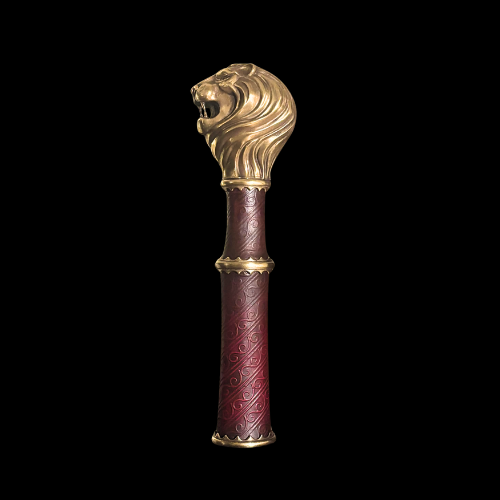
With the leatherwork nearing completion, the grip still looked unmistakably like a prototype. The ferrules and lion pommel were still resin. Rhindon's hilt relies heavily on the contrast between its deep ruby leather and the bright, aged metal surrounding it. Without that metallic finish, even the most accurate shapes struggled to feel convincing. Luckily with this project the most important aspect of the grip was already spot on in while in it’s resin form: the weight. The pommel itself already carried extraordinary weight, adding metal to it would make it feel like a real grip, with no way of knowing that there’s resin underneath.
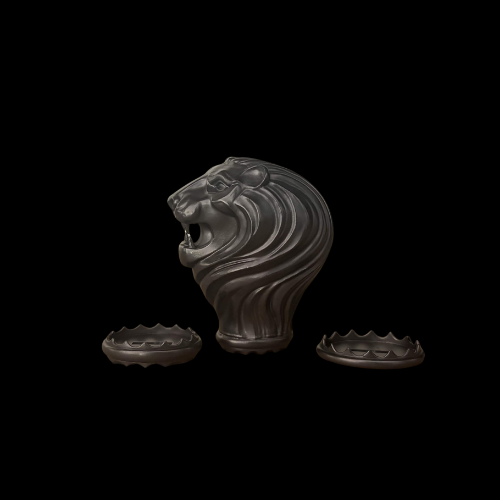
For Prototype V1, we once again turned to a process that has become increasingly important within our workshop: electroplating. The resin pieces were carefully prepared before receiving a conductive coating, allowing a real layer of metal to be deposited across their surfaces. Copper formed the foundation of the plating process, building a metallic shell over the printed parts and giving us a surface that could be refined, polished and prepared for its final finish. This stage was particularly unforgiving on the lion pommel. Every ridge of the mane, every recess around the eyes and every small transition across the muzzle remained visible beneath the plating. Metal does not magically hide an imperfect sculpt. If anything, its reflections make those imperfections considerably easier to see.
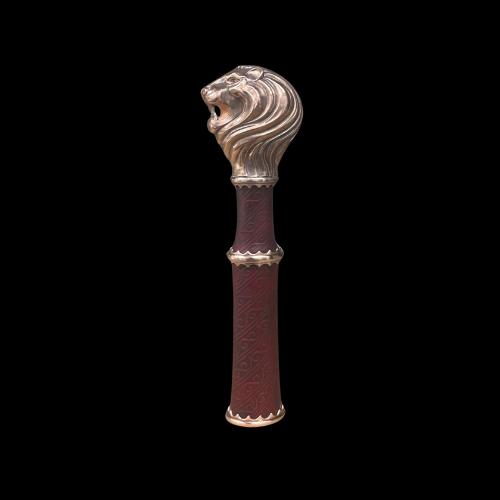
After the copper stage, the hardest and most time-consuming part of finishing these pieces began: polishing. Polishing is perhaps the most important step in the entire plating process. It is what transforms a visibly plated surface into something that begins to carry the depth, reflections and character of real metal. In the end, approximately five hours of polishing alone went into the pommel and ferrules of Prototype V1. And even after those 5 hours, there were still areas we knew could be improved for the official product.
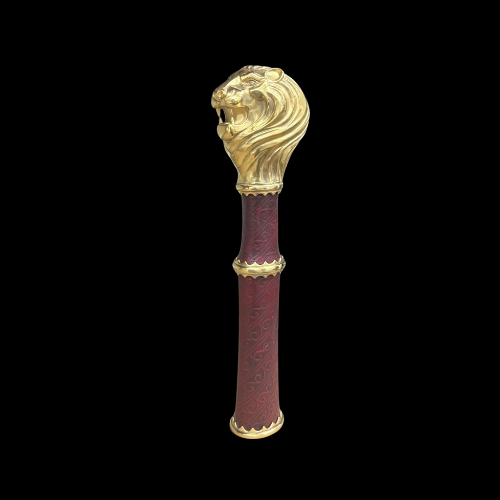
After the copper stage, a durable layer of palladium was applied, creating a strong foundation for the final finish. The pieces were then plated with a substantial coating of real 24-karat gold, bringing the warmth and richness so characteristic of Rhindon's hilt. This was the moment the ferrules and lion pommel truly began to transform from plated resin components into convincing metalwork.
Making New Metal Look Old
A perfectly clean, uniformly polished finish simply did not look like Rhindon. The original prop carries depth. Dark tones sit within the mane, around the lion's features and inside the smallest ornamental details of the ferrules. The raised surfaces, meanwhile, catch the light and appear naturally brighter. To recreate this appearance, the plated pieces were deliberately aged and then selectively refined. Recesses were allowed to remain dark while the highest surfaces were brought back to a brighter metallic finish.
One of the greatest shortcomings we often see in officially licensed replicas is a simple one: they try to replicate the prop instead of trying to make the prop. There is a difference. Rhindon was never meant to look as though it had just left a modern production line. The original was created as an object with presence, character and history. A perfectly uniform gold finish may look beautiful, but it does not necessarily look like Rhindon. Our result was not meant to look newly manufactured. It was meant to look like an object with history.
The metal was therefore carefully aged by hand. Once the plated lion was placed above the finished ruby leather, Prototype V1 suddenly stopped feeling like a collection of separately manufactured components. For the first time, the grip began to carry the presence of the original prop. And perhaps more than any other stage of this prototype, the metal finishing proved just how important the final surface can be.
A design can establish the likeness. But the finish is what finally brings it to life.
6. Putting It All Together
After months of research, design, leather testing, plating and finishing, there was finally only one thing left to do.
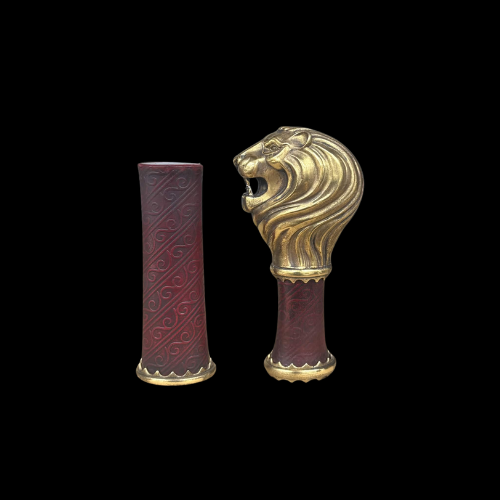
Put it all together. Until this point, every component of Prototype V1 had largely existed on its own. The leather had been developed separately from the ferrules. The lion had spent dozens of hours as a digital sculpt before becoming a physical, plated object. Each piece had been judged and refined individually. But Rhindon's grip is not a collection of individual parts. It is the way those parts come together that creates the prop.
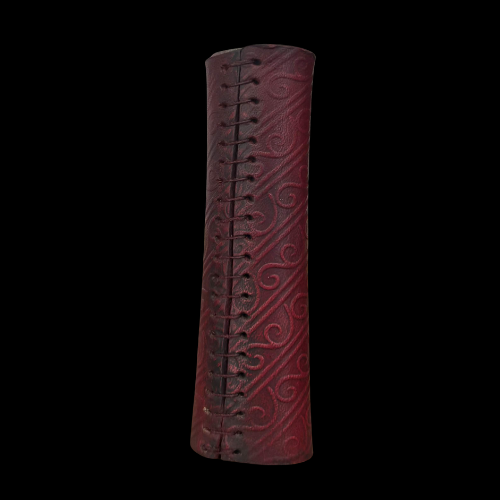
the two leather sections were carefully wrapped around their grip cores and stitched by hand along the back. The stitching itself was recreated to closely resemble that seen on the original prop. Everything from the thickness of the thread to its colour and the spacing of each stitch played an important role in achieving the correct appearance. For Prototype V1, it was incredibly important to us that the rear seam remained as clean and consistent as possible. After spending so much time recreating the front of Rhindon's grip, we did not want the craftsmanship to end the moment the replica was turned around.
The ferrules were positioned between each transition, and finally the lion pommel was placed proudly at the top. For the first time, we were able to hold the complete grip in our hands. This was the moment the entire project changed. The ruby-red leather, aged 24-karat gold and weight of the plated pommel suddenly worked together as one object. What had previously existed as measurements, files and individual test pieces finally began to feel like Rhindon.
Potential Turned Into Possibility, Possibility Turned Into Reality
Rhindon is a project we have always wanted to create. But, for a long time it simply felt too complicated for us at the moment. Years ago, we offered a considerably simpler version of Rhindon for pre-order. It was offered at a lower price and developed to a very different standard than the Replica Collection of today. Yet even then, the project’s pre-orders underperformed. It left us questioning something important: Is there even room for a truly accurate Rhindon replica on the market? There is perhaps no better time to find out than now.
Over the past six years, working exclusively on replicas from The Chronicles of Narnia, we have learned an extraordinary amount. We have studied how the original props were constructed. We have recreated their finishes, colours, shapes and smallest details. We have failed, tested, rebuilt and refined our processes time and time again. And today, we finally believe we have everything we need to make Rhindon into the replica it always had the potential to be.
That is also why Rhindon will be our most expensive and premium product to date. This replica is not for everyone, we know that it can be out of reach and not intended for the casual collector. It is for the collector who has always wanted a Rhindon that simply looks right. Someone who has waited years for a replica, and now are willing to go all the way.
The finished grip prototype has made the potential of this project undeniable to us. The weight alone changes the experience. The texture of real leather beneath your hand. The cold touch of metal. Our ambition is clear: to create the most accurate replica of Rhindon ever made.
Officially licensed studios may sometimes have access to original props, moulds or direct production material. We do not. We are reconstructing Rhindon from references, original measurements and years of specialised experience with Narnian props. Six years of focusing on these replicas have brought us here. We know the details and we know the colours and we know we can make this product.
Rhindon is shaping up to become our most exclusive replica yet. Each sword will be individually numbered and produced one at a time, with the attention this project demands. But we can only bring it to life if the project reaches its minimum pre-order threshold of three collectors. Prototype V1 was created partly because we wanted to give collectors something more than a promise. We wanted to show the craftsmanship, the research and the physical proof that we believe we can pull this project off. Now, bringing the complete sword into existence requires the support of at least three collectors willing to take that next step with us. Three collectors to turn possibility into reality. And, hopefully, to finally bring Rhindon to the replica market in all its glory.
Prototype V1 has done it’s job. But of course, it is not perfect. Holding the prototype immediately revealed details that digital renders never could. The grip profile is slightly too oval and will become considerably more cylindrical for the official product. The ferrules may be redesigned once again for an even sharper and cleaner result. Even the leather patterns and final assembly process still have room for refinement. But that is precisely why Prototype V1 exists. It was never created to be the final Rhindon grip. It has given us our first physical glimpse at the potential of this project. The potential to become our most intricate replica yet — and the most accurate Rhindon replica ever made.
